
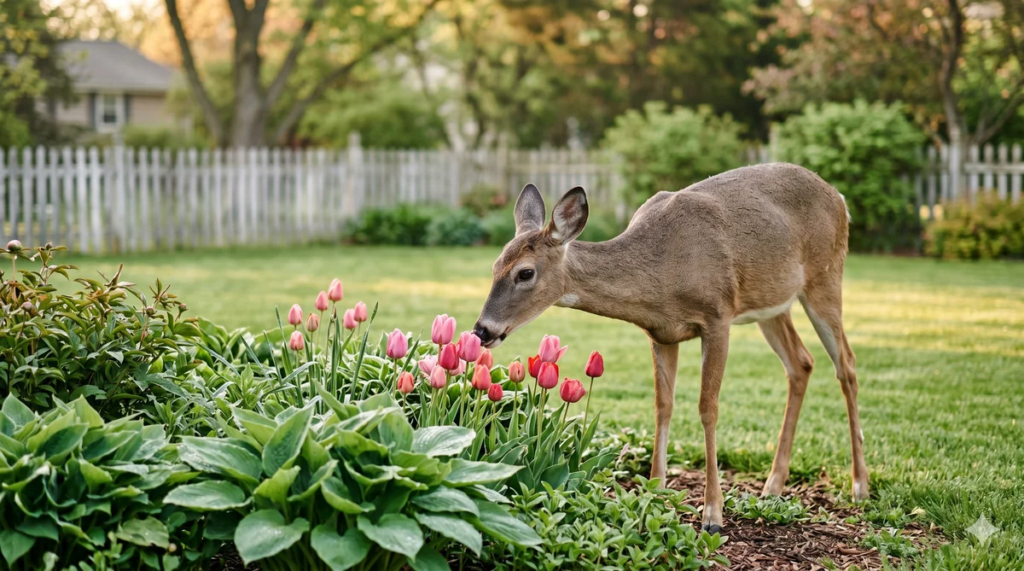
What Do Deer Eat? A Homeowner's Guide to Deer Feeding Habits
By Rachel Betzen, Owner, Wireless Deer Fence® Published June 10, 2026
- Deer eat four kinds of food — browse (twigs and leaves), forbs (broad-leaved plants), mast (nuts and fruit), and almost any tender garden plant — totaling 9 to 12 pounds of vegetation per day for an adult.
- Studies have documented more than 600 plant species in deer diets, with garden favorites like hostas, tulips, daylilies, and tender vegetables ranking at the top.
- Deer feeding patterns shift by season: tender shoots in spring, forbs and irrigated gardens in summer, mast in fall, and woody browse in winter.
- Knowing what deer eat is the first step. Stopping them from eating it takes a method that changes their behavior, not just a swap of plants.
If you've stepped into your yard to find hostas chewed to stubs, tulip stems where the flowers used to be, or rows of beans clipped overnight, you already know deer have a wide menu and a serious appetite. So what do deer eat? Almost anything tender, nutritious, and easy to reach, especially once a deer figures out your garden is on its nightly route.
This guide breaks down a deer's diet honestly. We'll cover what deer eat in the wild, what they target in suburban yards, how their feeding habits shift through the year, and the plants they tend to leave alone. By the end, you'll know exactly what's drawing them in and what it takes to keep them out.
What Do Deer Eat?
Deer eat four main categories of food: browse (the twigs, leaves, and buds of woody plants), forbs (broad-leaved herbaceous plants like clover and goldenrod), mast (hard nuts and soft fruits), and crops and ornamentals from human landscapes. Across the year, browse alone makes up about 46% of the diet, followed by forbs at 24% and mast at 11%.
White-tailed deer are technically herbivores, but they're also picky. They use a narrow snout and a long tongue to sort through plants and pick the most tender, most nutritious parts, skipping tough stems and older leaves. That selectivity is one reason gardens get hit so hard. Suburban yards offer concentrated, irrigated, fertilized plant matter in exactly the form deer prefer.
A Deer's Daily Diet by the Numbers
The numbers tell a story most homeowners don't expect. A healthy adult white-tailed deer eats roughly 6 to 8 percent of its body weight in food every day. For a 150-pound deer, that's 9 to 12 pounds of vegetation, or more than 3,000 pounds a year.
Their menu is also broader than most people realize. Researchers at the Mississippi State University Deer Lab have documented deer eating more than 400 plant species in the Southeast alone. In Missouri, food habit studies have identified over 600 species. The catch is that deer don't eat all of those equally. About a third of the plants on the list account for roughly 93 percent of what they actually consume.
Deer also feed on a tight schedule. They are crepuscular, meaning they're most active at dawn and dusk, with secondary feeding bouts throughout the night. That's why damage so often appears overnight, with no warning beyond a chewed leaf the next morning.
A Deer’s Daily Diet: By the Numbers
What the research says about how much, how often, and how varied
A 150-pound deer pulls over 3,000 pounds of plants from its range every year. In suburban yards, much of that often comes straight from the garden.
What Plants Do Deer Eat Most Often in Gardens?
The plants deer hit hardest in suburban yards are tender ornamentals and high-water vegetables. Top targets include hostas, tulips, daylilies, roses, arborvitae, and fruit trees, along with garden vegetables like beans, lettuce, peas, sweet corn, and strawberries. Anything soft, sweet, and well-watered is fair game.
There's a small group of vegetables that deer will usually leave alone unless they're desperate. Tomatoes and peppers from the nightshade family are considered moderately deer-resistant, as are root crops like onions and garlic. The catch is the word "moderately." When wild food is scarce, even tomato vines and hot peppers end up on the menu.
If you want a closer look at which crops hold up best, our overview of deer-resistant vegetables breaks them down by category.
Plants Deer Eat Most in Gardens: Quick Reference
Common targets in suburban yards, ranked by how likely deer are to browse them
| Plant | Type | Risk Level | Why Deer Target It | When Damage Peaks |
|---|---|---|---|---|
| Hostas | Foliage | Tender leaves, high water content | Spring through summer | |
| Tulips | Bulb | Sweet flower heads, early spring growth | Spring (especially early) | |
| Daylilies | Flower | Tender shoots and flower buds | Spring through midsummer | |
| Roses | Flower | Fragrant buds and new growth | Spring and early summer | |
| Beans | Vegetable | Tender leaves and pods | Summer | |
| Lettuce | Vegetable | Soft leaves, high moisture | Spring and fall | |
| Peas | Vegetable | Vines, pods, tender shoots | Spring and early summer | |
| Strawberries | Fruit | Sweet fruit and tender leaves | Late spring through summer | |
| Sweet Corn | Vegetable | Stalks, ears, and tassels | Mid to late summer | |
| Apple & Fruit Trees | Tree | Fallen fruit and tender new growth | Fall mast, winter browse | |
| Arborvitae | Shrub | Soft evergreen foliage, winter browse | Fall and winter | |
| Yew | Shrub | Evergreen foliage available year-round | Winter | |
| Impatiens | Flower | Tender stems, high water content | Spring through summer | |
| Tomatoes & Peppers | Vegetable | Moderately resistant unless food is scarce | Summer drought |
Targets compiled from UConn Extension, Missouri Department of Conservation, and Rutgers Deer-Resistance Ratings
How Does a Deer's Diet Change with the Seasons?
A deer's diet shifts dramatically through the year, following whatever is most nutritious and accessible. Spring brings tender new growth and high protein needs. Summer adds forbs and irrigated garden plants. Fall is driven by mast and fat-building. Winter forces them onto woody browse when nothing else is available.
Spring
In spring, deer focus on the first tender shoots they can find. Does in particular need extra nutrition before fawning, and new garden growth, fresh forbs, and emerging tree leaves are exactly what they're looking for. This is the season when most gardeners discover they have a deer problem.
Summer
By summer, forbs remain a major part of the diet. When natural forage dries out during heat or drought, irrigated suburban gardens stand out as the only lush food source for miles, which is why summer damage often catches gardeners off guard.
Fall
Fall is mast season. The share of mast in a deer's diet climbs from about 11% in summer to 28% in autumn, driven mostly by hard mast like acorns and beechnuts. Deer also fatten up before winter, which means heavier browsing on anything still green in your yard.
Winter
Once the ground freezes and forbs disappear, deer fall back on woody browse: the twigs, buds, and bark of trees and shrubs. This is the leanest season for them and the most damaging time for fruit trees and ornamental shrubs.
Why Deer Keep Choosing Your Yard Over the Woods
Your yard isn't just a snack. To a deer, it's a reliable food source with low risk and high reward. Irrigation keeps plants soft and full of moisture. Fertilizer makes them nutrient-dense. Fences keep most predators out. Once a deer learns the route to your garden, it files the route away and comes back, sometimes for years.
That's why gardeners who lived deer-free for years can suddenly find a herd browsing the back beds once a new generation of deer learns the property. The food source is too good to pass up.
What Plants Do Deer Tend to Avoid?
Deer typically avoid plants that are strongly aromatic (lavender, rosemary, Russian sage, catmint), toxic (daffodils, foxglove, lily of the valley), fuzzy or coarse (lamb's ear, ornamental grasses), or heavily thorny (barberry, holly). Rutgers University maintains one of the most reliable deer-resistance rating systems, ranking hundreds of landscape plants from "rarely damaged" to "frequently severely damaged."
The honest caveat: "deer-resistant" is not "deer-proof." When food is scarce, hungry deer will eat plants the books say they should leave alone. Resistant plants reduce browsing pressure, but they don't eliminate it. They work best alongside a method that actively keeps deer out of the yard.
How to Stop Deer from Eating Your Garden
Plant choice alone won't keep deer out. Sprays wash off in rain. Tall fences are expensive and change how a yard looks. Motion-activated devices stop working within a week as deer learn there's no real consequence behind the noise.
The approach that actually works is behavioral conditioning. The Wireless Deer Fence® was designed by a veterinarian to train deer through a single contact. The posts draw deer in with a scent, deliver a humane startling shock when touched, and create a lasting association that keeps deer away from the area. No constant spraying. No habituation curve.
Our complete guide to keeping deer out of your garden walks through every protection method honestly and shows where conditioning fits into a layered strategy. If you have specific questions about how the system works, the product FAQ covers placement, attractants, and what to expect.
Conclusion
Deer eat a lot, they eat a wide range of plants, and once they find your garden they'll keep coming back. Knowing what's on their menu is helpful. Stopping them from eating it is what protects your yard year after year.
Ready to Stop Sharing Your Garden with Deer?
The Wireless Deer Fence® is a veterinarian-designed training system that conditions deer to avoid your yard after a single contact. No wires, no chemicals, no constant reapplication. Backed by a two-year money-back guarantee.
Order Your Wireless Deer Fence®
Free shipping available. Guaranteed to work or your money back.
Frequently Asked Questions
What plants do deer eat the most?
Deer eat hostas, tulips, daylilies, roses, arborvitae, and fruit trees most often in suburban yards, along with garden vegetables like beans, lettuce, peas, sweet corn, and strawberries. Soft, sweet, well-watered plants are the highest-risk targets.
Do deer eat tomatoes and peppers?
Usually not. Tomatoes and peppers belong to the nightshade family and are considered moderately deer-resistant. When wild food sources run short, however, deer will eat almost any vegetable, including tomato vines and hot peppers.
What time of day do deer feed?
Deer are crepuscular, which means they feed most actively at dawn and dusk. They also feed throughout the night, especially during the warm months, which is why most garden damage shows up overnight.
How much does one deer eat in a day?
A healthy adult white-tailed deer eats roughly 6 to 8 percent of its body weight in vegetation each day. For a 150-pound deer, that's 9 to 12 pounds of plant material, or more than 3,000 pounds per year.
Will deer eat through a garden fence?
Deer don't chew through fences. They jump them, push under them, or squeeze through gaps. That's why a deer fence needs to be at least eight feet tall, fully enclosed, and free of gaps to be effective. Our overview of deer fence options compares the most common designs.
About the Author
Rachel Betzen
Owner, Wireless Deer Fence®
